
Choosing between swing gates and sliding gates is one of the most important decisions a property owner makes when planning a new entrance. Get it right and the gate serves the property beautifully for decades. Get it wrong and the problems start on day one, from gates that cannot open fully to automation systems that fail under the wrong conditions.
In this guide, we cover how each gate type works, the key differences between them, the pros and cons of each, and how to choose the right gate for your specific property. Both gate types can be automated, electrified, and customised to suit a wide range of layouts, security needs, and design preferences. With 25 years of experience, Stargate helps UK homeowners and commercial property owners invest in the right solution from the start.
Key Takeaways
- Swing gates rotate on hinge posts and require clearance space in the arc of movement; sliding gates travel horizontally along the fence line and require run-back space to one side.
- Sliding gates suit sloped or uneven driveways, restricted spaces, and high-usage commercial applications; swing gates suit level, spacious driveways where a traditional aesthetic is a priority.
- Both gate types can be fully automated as electric gates, with a range of motor and access control options available.
- Aluminium gates from Stargate are available in swing and sliding configurations, with a 10-year finish guarantee and 5-year structural guarantee on every installation.
- A professional site assessment is always the best starting point before choosing between gate types.
What Are Swing Gates and How Do They Work?
A swing gate is a gate that opens by rotating on hinges attached to a fixed post, swinging either inward or outward in a wide arc to allow access. They can be installed as a single swing gate covering the full entrance width, or as double swing gates with two leaves that meet in the centre.
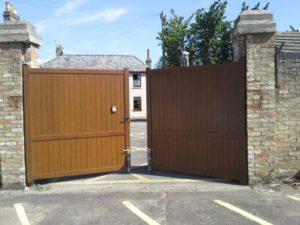
The gate leaf rotates on hinge posts, requiring sufficient clearance space in front of or behind the gate for the arc of movement. For double swing gates, each leaf swings outward or inward simultaneously, creating a wide half circle of movement on either side of the gate line. This swing distance must be kept clear of obstructions at all times.
Swing gates can be manually operated or fitted with automation systems including underground or above-ground motors. Level ground is strongly preferable. Sloped or uneven driveways create significant challenges for swing gate installation and operation, as the gate leaf needs to clear the ground surface throughout its full arc of movement. Stargate installs both single and double swing aluminium gates across residential and commercial properties, with expert assessment of site conditions before installation begins.
What Are Sliding Gates and How Do They Work?
A sliding gate is a gate that moves horizontally along a fixed track or cantilever system, sliding parallel to the fence line rather than swinging open. The gate travels sideways to open and close, requiring side space along the fence line rather than clearance in front of or behind the gate.
There are two main sliding gate mechanisms. Track-based systems run on slide tracks embedded in the ground. Cantilever sliding gate systems are suspended above the ground on a beam, requiring no ground track but needing sufficient side clearance for the counterbalance section. The cantilever system is particularly valued for properties with uneven driveways, sloped ground, or settings where a ground track would be impractical.
Sliding electric gates can be automated with high-performance motors suited to heavy gates and high-cycle commercial applications, including car parks and industrial sites. Stargate supplies and installs both track and cantilever systems, advising on the most appropriate mechanism for each property’s layout and usage requirements.
Key Differences Between Swing and Sliding Gates
The choice between swing vs sliding gates comes down to a small number of factors, but those factors matter enormously. Here is how the two gate types compare across the dimensions that matter most.
Space, Ground Conditions, and Layout Considerations
Space is the primary deciding factor for most properties. Swing gates require clearance in the arc of movement, either into the driveway or outward onto the road. Sliding gates require run-back space along the fence line. The right choice depends entirely on which type of space the property has available.
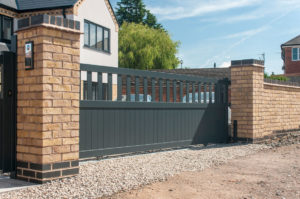
Ground conditions are equally important. Swing gates need level ground to operate correctly. On sloped or uneven driveways, the gate leaf may drag, bind, or fail to open properly. Sliding gates, particularly cantilever systems, perform well on uneven ground where swing gates would struggle. For narrow driveways with limited space on both sides, a specialist assessment is always recommended before committing to either gate type.
Security, Maintenance, and Cost Differences
Sliding gates are generally harder to force open due to the lateral resistance of the mechanism, giving them stronger security credentials than swing gates in most applications. Swing gates can be vulnerable to being pushed open if the automation or locking system is compromised.
On maintenance, swing gates have fewer components and require less day-to-day attention. Sliding gates with ground tracks require regular track maintenance to prevent debris accumulation and ensure smooth operation. On cost, swing gates typically carry a lower initial investment. Sliding gate systems are more complex and cost more to install, but may offer better long-term value on challenging sites.
Pros and Cons of Swing Gates
The Advantages of Swing Gates
- Cost-effective installation with fewer components than sliding gate systems
- Simpler mechanism requiring minimal maintenance over the gate’s working life
- Traditional aesthetic that suits period properties, rural settings, and classic driveway designs
- Wide range of design options, from classic to contemporary aluminium gate styles
- Easy to automate with a range of motor types including underground and above-ground systems
- Suitable for wider entrances when double swing gates are used
- Lower initial investment compared to equivalent sliding gate systems
Limitations and Installation Considerations for Swing Gates
- Require significant clearance space to swing freely, either into the driveway or outward
- Not suitable for sloped or uneven driveways without significant groundwork
- Can be affected by strong wind if not properly weighted or secured
- Opening outward requires careful consideration of traffic and pedestrian safety
- The wide half circle of movement limits what can be placed in the swing zone
- Hinge posts must be robust enough to carry all the weight of the gate leaf over years of use
Swing gates are well suited to spacious driveways and residential properties where the traditional aesthetic is a priority and the property layout allows for the required swing distance. All automated swing gate systems must meet current UK safety regulations, including safety sensors, safety features, and force testing requirements. Stargate installs swing gate systems to exacting standards, with full attention to safety compliance and automation integration.
Pros and Cons of Sliding Gates
The Advantages of Sliding Gates
- Space-efficient operation requiring no swing clearance in front of or behind the gate
- Highly suitable for sloped or uneven driveways, particularly with cantilever systems
- Robust security credentials as sliding gates are difficult to force open
- Excellent performance under high usage conditions, ideal for car parks and commercial premises
- Unaffected by wind interference and smooth operation in all weather conditions
- Contemporary aesthetic that suits modern properties and wider entrances
- Accommodate wider driveway openings with a single gate leaf
Limitations and Installation Considerations for Sliding Gates
- Require sufficient side space along the fence line for the gate to retract into
- More complex mechanism with more components than swing gate systems
- Ground track systems require regular track maintenance to keep clear of debris
- Higher installation cost than comparable swing gate systems
- Cantilever systems require careful structural installation to manage all the weight on the beam
Sliding gates are particularly well suited to properties with limited space in front of the gate, such as those close to a road or with short driveways where swing gates would create a hazard. Their enhanced security and high-usage tolerance also make them the preferred choice for commercial applications. Proper installation by experienced gate engineers is essential given the complexity of the mechanism.
How to Choose the Right Gate for Your Property
Use this step-by-step framework to identify the most suitable gate type for your property.

- Assess your available space. Measure the entrance width and determine how much space is available in front of, behind, and to the side of the gate position. This single factor often determines which gate type is viable.
- Assess your ground conditions. Is the driveway level or sloped? Uneven ground strongly favours sliding gates, particularly cantilever systems. Level, spacious driveways can accommodate either type.
- Define your security requirements. Consider the level of access control you need, whether the property is residential or commercial, and how important it is that the gate resists unauthorised access.
- Consider usage frequency. High-usage applications such as commercial premises or car parks benefit from the durability of sliding gate systems. Standard residential use suits either type.
- Establish your design priorities. If traditional aesthetic and kerb appeal are key factors, swing gates are often more suitable. If contemporary design and seamless integration with a modern property are the goal, sliding gates tend to deliver better results.
- Set your budget. Sliding gates typically carry a higher initial cost, but may offer better long-term value in challenging site conditions. Both gate types are available at a range of price points.
- Consult a specialist. A professional gate installer will assess the site and make a recommendation based on all the factors above, ensuring the chosen system performs reliably for years to come.
Why Choose Stargate for Your Gate Installation?
With 25 years of experience, Stargate is a trusted gate installation, automation, and maintenance specialist delivering high-quality aluminium gate solutions for residential and commercial properties across the UK. We are not just a gate supplier; we provide a complete service from initial site assessment through to installation, automation, and long-term maintenance.
Our full aluminium gate range is available in both swing and sliding configurations, with classic and contemporary designs and a full range of colour and finish options including wood effect finishes. Every gate we install comes with a 10-year finish guarantee and 5-year structural guarantee, giving customers complete confidence in the quality and longevity of their investment.
Stargate assesses every property individually and recommends the right gate system based on actual site conditions, security needs, and design preferences. We never push a one-size-fits-all solution. Contact us today to book a site assessment, discuss your gate design options, or get a quote for a new gate installation or automation upgrade.
If you’re planning an automated entrance, our guide to buying automatic gates explains the key considerations before choosing your system.
The Right Gate Makes All the Difference
Choosing between swing vs sliding gates comes down to three primary factors: the space available at your property, the ground conditions on and around your driveway, and your security and usage requirements. Swing gates suit level, spacious driveways with room to swing freely, offer a traditional aesthetic, and are typically lower in initial cost. Sliding gates suit sloped or restricted driveways, offer stronger security credentials, and perform better under high usage conditions.
Both gate types can be automated, designed to a high standard, and maintained for decades of reliable service when properly installed by an experienced specialist. Contact Stargate to discuss your gate project, book a site assessment, or explore the full range of sliding, swing, and automated aluminium gate solutions.